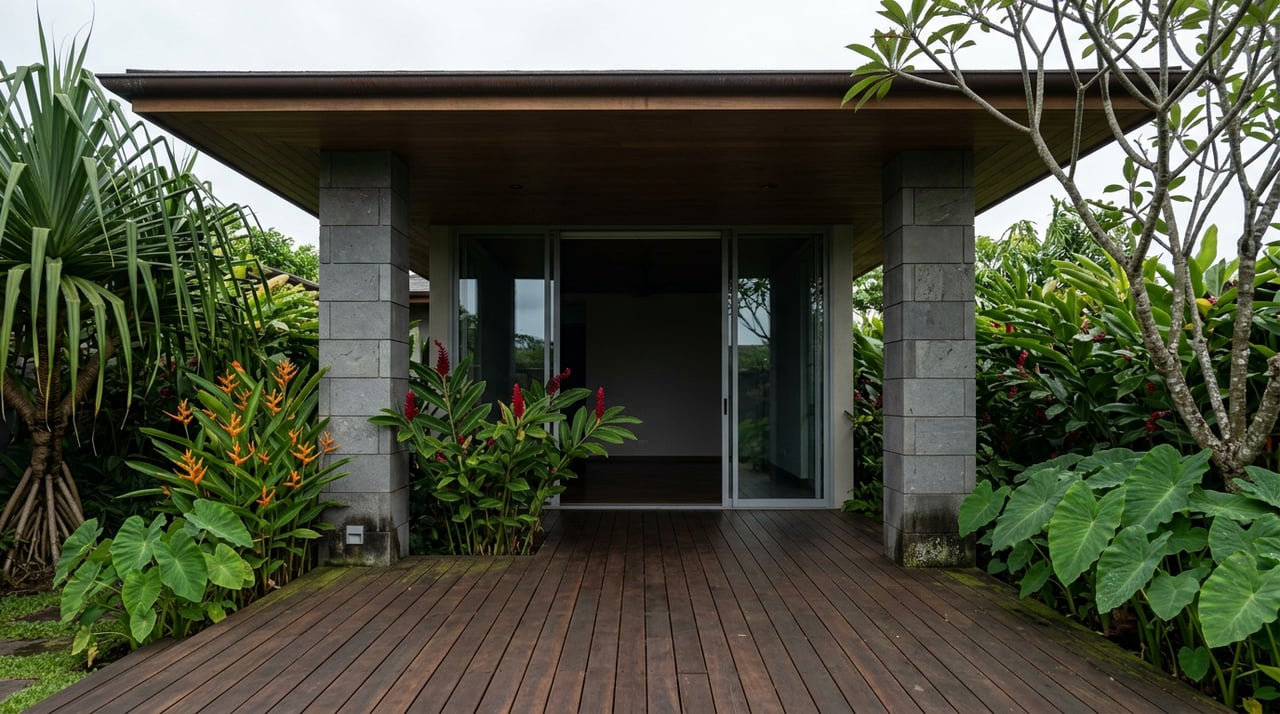
The drive from Paia to Haiku takes roughly ten minutes on the Hana Highway, but the shift in atmosphere is instant. Tour vans thin out. The roadside gives way to ferns, mailboxes, and hand-lettered farm signs. The air gets softer.
Then you turn onto Haiku Road, pull into a parking lot in front of what looks like a low industrial complex, and smell coffee. That building is the Haiku Marketplace, and the coffee is coming from inside what was once a working pineapple cannery. The industry that defined the North Shore for most of the twentieth century is long gone, but the structures it left behind are not. The residents of Haiku-Pauwela moved into them — and that quiet act of reuse is the most honest explanation for why daily life here feels unlike anything else on Maui.
Most neighborhoods are designed around their social spaces. Haiku-Pauwela inherited its social spaces from a different economy entirely, and the result is a place with a texture that cannot be replicated by new construction or deliberate placemaking.
Two Canneries, Two Different Hours of the Day
The Haiku Marketplace at 810 Haiku Road is the neighborhood's most active crossroads, and Colleen's at the Cannery is the reason most people stop. Open since 1996, the restaurant occupies the old cannery floor with its original vaulted ceiling and whirring overhead fans. It runs breakfast starting at 7 a.m., transitions through lunch, and anchors happy hour daily from 3:30 to 5:30 p.m. Dinner runs until 9:30. Burgers are made with Maui Cattle Company hormone-free beef; the fresh catch changes with what's available locally. The crowd at any given hour skews toward people who actually live here — which is exactly the signal worth paying attention to.
Less than two miles away, the Pauwela Cannery on West Kuiaha Road is the quieter of the two. Where the Haiku Marketplace became a food and community hub, the Pauwela Cannery went sideways into craft: surfboard shapers, art galleries, artist studios, and carpentry workshops now occupy the manufacturing bays. The Baked On Maui Café handles coffee and pastries. A Dakine outlet occupies one of the warehouse units. The cannery still smells faintly of industrial history, which only adds to the appeal for the artists and makers who showed up first.
These two buildings form something like the neighborhood's morning and afternoon poles. Colleen's is where you eat breakfast before a hike or linger over a late lunch. The Pauwela Cannery is where you wander on a slow Tuesday, pick up a croissant, and end up talking to a surfboard shaper for twenty minutes.
| Colleen's at the Cannery | Nuka | |
|---|---|---|
| Address | 810 Haiku Rd, Suite 19 | 780 Haiku Rd |
| Hours | 7 a.m. – 9:30 p.m. daily | Dinner from 4:30 p.m. |
| Reservations | Yes | No — arrive before 4:15 p.m. |
| Best for | Breakfast, lunch, happy hour | Evening izakaya, sushi, sake |
| Local signal | Regulars at every meal | Lines out the door by 5:30 p.m. |
The Farm Stands That Mark the Week
In a neighborhood where the land still produces food, the farmers market is less an amenity than a recurring social event. Maliko Country Farms operates a farm stand at 2250 Hana Highway every Wednesday and Friday from 9 a.m. to 2 p.m. The produce is grown on-site; the stand is not a curated market experience but the actual output of an actual farm on the North Shore. For residents, the Wednesday run is often when the week acquires its shape.
A few miles toward Paia on Baldwin Avenue, La'akea Village runs a farm community with a public market and volunteer-for-a-day programming. The nonprofit model is specific to La'akea — the organization was inspired by the Camphill Villages movement and supports residents with developmental disabilities through farming and the arts — but the farm stand is open to the public and draws regulars who return as much for the people as for the produce.
What these markets share is not a style or a format. They share a relationship to the land that predates the word "farm-to-table." The farms were here before the phrase.
This is the part of Haiku-Pauwela that visitors almost never see and that residents rarely explain to outsiders, because it feels obvious from inside. The social calendar in this neighborhood is organized around harvests and market days, not around restaurant reservations or event listings.
The Evening That Earns Its Wait
Nuka, the 50-seat izakaya at 780 Haiku Road, does not take reservations. It opens for dinner at 4:30 p.m. and, on weekends, the wait by 5:30 can stretch to 90 minutes. The correct response, as any Haiku resident will tell you, is to arrive by 4:15 p.m. and consider the wait itself part of the evening — the North Shore air at dusk being what it is.
Chef Hiro Takanashi mills his own rice on-site; the nukazuke pickles that appear on the menu are made from the rice bran left behind in the milling process. Several daily specials draw on ingredients grown at Nuka's own farm. The izakaya format means small plates, sake, and the kind of slow dinner that does not resolve quickly or cheaply — which suits a neighborhood that is not in a hurry.
The restaurant has operated quietly in this spot while Maui's dining conversation orbited resort corridors and beachfront patios. The quality has not gone unnoticed: local reviews from early 2026 still describe it as one of the best restaurants on the island, not just the North Shore. The fact that it is tucked next to the Haiku post office, accessible by a parking lot shared with a row of day businesses, is very much part of the point.
The Ground Between the Stops
Not everything in Haiku-Pauwela runs through a building. The Sacred Garden of Maliko sits on eleven acres off the Hana Highway, certified as a wildlife sanctuary by the National Wildlife Federation, and functions as a botanical garden and bird sanctuary that the neighborhood treats as background rather than attraction. Leilani Farm Sanctuary at 260 East Kuiaha Road is a working animal rescue with grounds open to visitors. NorthShore Zipline Co at 2065 Kauhikoa Road handles the requests from out-of-town guests when someone's family visits and needs a half-day activity.
These places are not the center of the neighborhood's social life. They are its perimeter — the reason residents describe the sense of space here as something you feel, not just measure. The lot sizes and the lush canopy do part of that work. The proximity of working farms and sanctuaries and trails does the rest.
What This Neighborhood Actually Is
The clearest thing the research says about Haiku-Pauwela is this: the neighborhood did not build its identity from scratch. It found its identity already sitting in old industrial buildings and farmland, and it chose to inhabit those structures rather than replace them. Colleen's did not open in a purpose-built restaurant space; it opened in a cannery. Nuka did not open in a resort corridor; it opened next to the post office. The farm stands were farms before they were markets.
That distinction matters for anyone who spends time thinking about where to live on Maui. Resort-adjacent neighborhoods offer polish and proximity. Haiku-Pauwela offers something harder to source: a place that feels like it has been itself for a while, and intends to stay that way.
If the North Shore is a neighborhood you are genuinely considering, the nuances of what daily life looks like here — and what that means for the properties available — are worth a real conversation. Lena Walleng Island Properties works across Maui's submarkets with the kind of specificity this decision requires. Reach out when you are ready to talk.